Held in the Hand: The Quiet Return of the Printed Photograph in a Scroll-Weary America
Somewhere in a Brooklyn apartment, a twenty-six-year-old is flipping through a linen-bound photo book of her grandmother's final year. She has four thousand images of that same year on her phone. She has looked at perhaps a dozen of them since the funeral.
The book, she will tell you, is different. The book is real.
Across the United States, a generation raised on infinite camera rolls is rediscovering the printed photograph — and photographers who build their businesses around tangible products are discovering that the most analog offering in their catalog may also be the most durable.
The Weight of the Physical
There is a reason the mantel photograph has outlived every format that promised to replace it. A print demands a decision. Someone chose that image, chose its size, chose its paper, chose the wall it would live on. That sequence of choices is what transforms a file into an heirloom.
Psychologists who study memory and object attachment have long noted that physical artifacts anchor recollection in ways screens do not. A photograph on a phone is one swipe away from oblivion — buried under screenshots, groceries, and the endless churn of the feed. A photograph on paper occupies space. It accumulates fingerprints, sun-fading, and the small damages of a life actually lived.
For clients who came of age after the smartphone, this tangibility carries an almost novelty value. Many millennials printed nothing from their weddings beyond what their photographer included. Now, watching their own parents' shoeboxes of Kodachrome outlast every hard drive from the 2000s, they are reconsidering.
From Deliverables to Heirlooms
The commercial implications are significant. For two decades, the prevailing model treated prints as an afterthought — clients received a gallery link, downloaded everything, and the transaction ended. Photographers competed on delivery speed and image count, a race to the bottom that commodified their work.
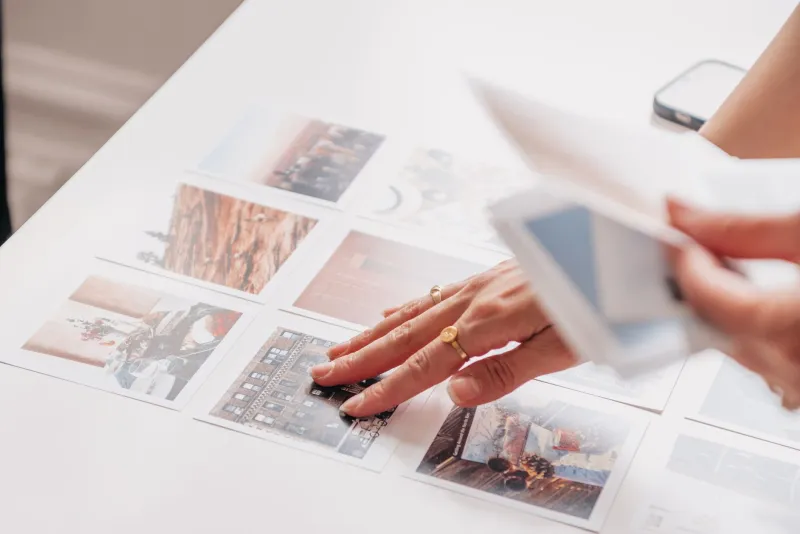
The print revival inverts that logic. Studios from Portland to Charleston are restructuring their packages around tangible outcomes: hand-bound albums, museum-grade matte prints, archival boxes of small prints meant to be passed around a living room rather than swiped through. Sessions are priced around what the client will hold in ten years, not how many files they will receive.
The economics reward this shift. A digital gallery is a cost center; a finished album is a product with margin. More importantly, it changes the conversation. A client who commissions a wall portrait is collaborating on an object for their home. A client who receives a download link is completing a transaction. Photographers consistently report that the former relationship deepens — leading to newborn sessions, anniversary commissions, and referrals in ways a folder of JPEGs never does.
The Craft Premium
None of this works without craft. The generation walking into print shops for the first time is also the generation discovering that paper choice matters, that a matte cotton rag behaves differently under living room light than a glossy stock ever could, that a properly framed piece changes the character of a room.
Photographers who educate their clients — who explain why archival inks matter, why a professional print lab differs from a drugstore kiosk — position themselves as experts rather than vendors. That expertise justifies premium pricing, and it aligns with a broader cultural moment in which young American consumers increasingly pay for provenance and permanence: vinyl records, hardcover editions, handmade furniture.
The photograph, it turns out, belongs squarely in that movement. A signed print from a session with a photographer whose work the client admires functions less like a purchase and more like collecting — a small, personal piece of art with a story attached.
Impermanence as an Argument
There is also a harder edge to this trend. The platforms where digital photographs live are not neutral custodians. Services shut down. Storage policies change. Hard drives fail with indifferent regularity. Anyone who lost a decade of images to a corrupted drive understands the argument viscerally.
Framing the print as an act of preservation — not nostalgia — gives photographers a message that resonates beyond sentiment. The printed photograph requires no subscription, no password, no compatible device. It survives its owner. That durability is precisely what makes it meaningful to clients documenting aging parents, growing children, and the fleeting chapters of their own lives.
What Comes Next
No one expects the camera roll to disappear, nor should it. The digital image remains the lingua franca of sharing and immediacy. But the American photography market is clearly splitting into two economies: the ephemeral and the enduring. The first is abundant, free, and forgettable. The second is curated, physical, and priced accordingly.
For photographers, the opportunity is to decide which economy they serve. Those who master the print — its papers, its presentation, its emotional gravity — are not retreating from modernity. They are offering the one thing a screen has never delivered: a photograph you can hold on the worst day of your life, years after the phone that took it is gone.
Light, captured. Stories, told. Art, made — and now, increasingly, held.