A Decade in the Frame: The Photographers Who Keep Coming Back
The first session is a performance. The second is a conversation. By the tenth, it's something closer to memory itself being made in real time.
That progression sits at the heart of a quiet tradition in American photography: the practitioner who stays. While the industry often celebrates the one perfect wedding or the viral portrait session, a smaller and arguably more significant craft has been developing in studios from Portland, Maine, to Portland, Oregon—the practice of photographing the same people across the long arc of their lives.
Beyond the Single Session
Most commercial photography is structured around milestones, treated as isolated events. A wedding happens. A newborn arrives. A senior graduate poses in a cap and gown. Each booking is a transaction with a beginning and an end.
Photographers who work longitudinally reject that structure. They treat the milestone not as the product but as one chapter in an ongoing visual record. The wedding album becomes volume one. The maternity session, the nursery portraits, the tenth-anniversary sitting—these become volumes two through ten.
The technical implications are substantial. Longitudinal work demands consistency and evolution in equal measure. A photographer returning to the same family must decide whether to replicate the original lighting scheme for continuity's sake or to let their style mature alongside their subjects. The best practitioners do both: they preserve certain anchors—location, focal length, even a favored window's light—while allowing technique to advance.
What Ten Years Teaches the Eye
There is a technical fluency that only repetition produces. A photographer who has photographed a couple five times knows which side of the bride's face carries her mother's smile. They know the child who needed twenty minutes to warm up at age three will, at thirteen, command the frame the moment the shutter is raised.
This knowledge changes how sessions are run. There is less direction and more observation. The photographer stops manufacturing moments and starts anticipating them. Veteran family photographers describe a kind of shorthand that develops—the ability to read a room, to know that the grandfather will only relax once the formal groupings are finished, and to save the best light for afterward.
The craft refinement is real, but so is the emotional deepening. A photographer who has documented a family through loss, relocation, illness, and reunion is no longer executing assignments. They are holding a narrative that belongs partly to them.
The Archive as Artwork
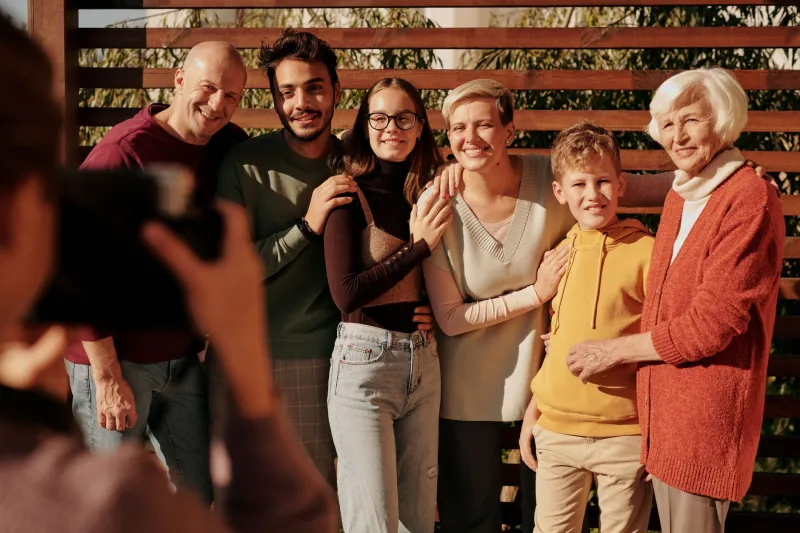
Viewed as a whole, a decade-long client relationship produces something no single session can: a portrait of time itself. The background wall may remain constant while everyone in front of it grows, ages, and multiplies. That juxtaposition—permanence against change—is among the most powerful effects available to the portrait photographer, and it cannot be staged. It can only be waited for.
Some photographers structure their businesses around this explicitly, offering anniversary sittings at reduced rates or building multi-year collections into their packages. Others simply let the relationships happen and discover, ten years in, that they have assembled an archive of extraordinary value.
That archive serves the client, naturally. Families who have grown up in front of one photographer's lens possess a coherent visual history that scattered snapshots can never replicate. But it serves the photographer too. When these practitioners assemble their portfolios, it is rarely the single striking image that defines their work—it is the grid of ten portraits of the same person, each one true, each one different.
The Business of Staying
There is a practical lesson here for working photographers. Client retention is among the most reliable predictors of studio longevity, and longitudinal relationships compound: the couple becomes parents, the parents bring grandparents, the children become seniors, and eventually the seniors return with partners of their own.
But the economics, while welcome, are almost beside the point. Ask photographers who have maintained these decade-spanning relationships what the work means to them, and the answer tends to be the same: it is the most meaningful work they make. Not the most technically difficult, not the most lucrative per hour—but the work that will outlast them.
Every photograph is, in one sense, a bet against forgetting. The photographer who returns year after year is simply making that bet with greater conviction. The frames accumulate. The story lengthens. And somewhere in the sequence—between the wedding and the golden anniversary—documentation quietly becomes legacy.