Six Blocks, Ten Thousand Frames: The Photographers Who Refuse to Wander
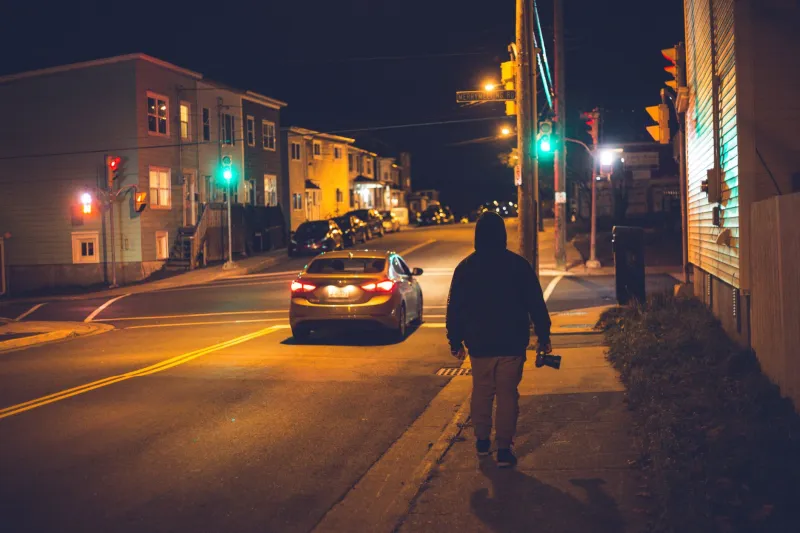
Every photographer eventually confronts the same anxious question: am I shooting enough of the world? The prevailing mythology of the craft — built on road trips, far-flung assignments, and the romance of the unfamiliar — suggests that the answer lies in motion. But a quiet countertradition is flourishing on unremarkable street corners, in neighborhood diners, and along the same half-mile of cracked pavement, where certain photographers have decided that the surest path to revelation is repetition.
The Case for a Small Territory
The photographers who work this way rarely describe it as a limitation. They describe it as a contract. By fixing the geography, they free themselves to notice everything else: the shift in light between March and October, the family that changes vehicles every four years, the way a storefront ages after new ownership. A familiar block functions less like a subject and more like an instrument — one that rewards sustained attention with subtleties a passing visitor could never register.
This is not a new idea. Walker Evans circled the same Southern towns; Lee Friedlander has photographed the streets around his New England home for decades. What is new is how deliberately a younger generation of working photographers has embraced the approach as a professional strategy rather than a fallback.
Three Photographers, Three Corners of America
Consider three working photographers Kytography spoke with about the practice — each anchored to a patch of ground no larger than a few city blocks, each insistent that the constraint made the work possible rather than smaller.
In Pittsburgh, a documentary photographer has spent nine years photographing a single commercial corridor in Lawrenceville, returning weekly with the same camera and, increasingly, the same conversations. "The first year, I was photographing the street," she says. "By year four, I was photographing time." Her long-term presence changed the pictures themselves: shop owners stopped performing for the camera, and the frames grew candid in a way no one-shot visit could produce.
In rural Kansas, a landscape photographer has restricted a decade-long project to one stretch of Flint Hills road — roughly two miles, shot in every season and nearly every weather condition. His contact sheets read like a meditation on variation: the identical fence line rendered as a dozen different photographs by nothing more than fog, frost, and the angle of afternoon light. "Travel teaches you what places look like," he notes. "Staying teaches you what a place is."
And in a small New England mill town, a portrait photographer has spent six years making environmental portraits within walking distance of her studio, photographing the same subjects annually. The resulting series — a barber, a librarian, a pair of retired schoolteachers — doubles as a longitudinal record of a community aging in place. Her subjects, she says, now bring her story ideas. The photography became a relationship long before it became a body of work.
Why Constraint Works
There is a technical logic beneath the romance. Familiarity compresses the variables. When the location is constant, the photographer's eye is forced to work harder on everything that remains: gesture, light, timing, composition. It is the photographic equivalent of a pianist practicing scales — the repetition is not the point, but it is what makes the performance possible.
The approach also inverts the usual economics of image-making. Travel shoots are expensive, logistically fraught, and time-limited. A local project costs a pair of shoes and a thermos. For photographers building personal work between client commitments, proximity is not a compromise; it is the only sustainable model.
Perhaps most importantly, repetition builds trust, and trust changes what a camera is permitted to see. Strangers get one expression; neighbors get many. Over years, the photographer stops being an observer and becomes something closer to a witness — a distinction that shows in every frame.
The Discipline of Returning
None of this is easy. The temptation to abandon a familiar subject for somewhere new is constant, and the middle years of any long-term project are notoriously demoralizing. The photographers we spoke with described elaborate self-negotiations: shooting the same corner at different hours, imposing formal constraints (one lens, one focal length, one hour of light) to force novelty out of sameness.
Their collective advice converges on a single principle: treat the familiar place as if you were seeing it for the first time, and treat the first visit as if you intended to stay forever. The first half keeps the eye honest. The second keeps the commitment alive.
The Larger Frame
In an era when portfolios are judged by their breadth and feeds reward novelty, the decision to stay put reads almost as dissent. But the work these photographers produce suggests that depth and breadth are not the only measures of vision. Sometimes the most complete portrait of America is made not by crossing the country, but by standing still long enough to let one small part of it reveal itself — season after season, year after year, six blocks at a time.