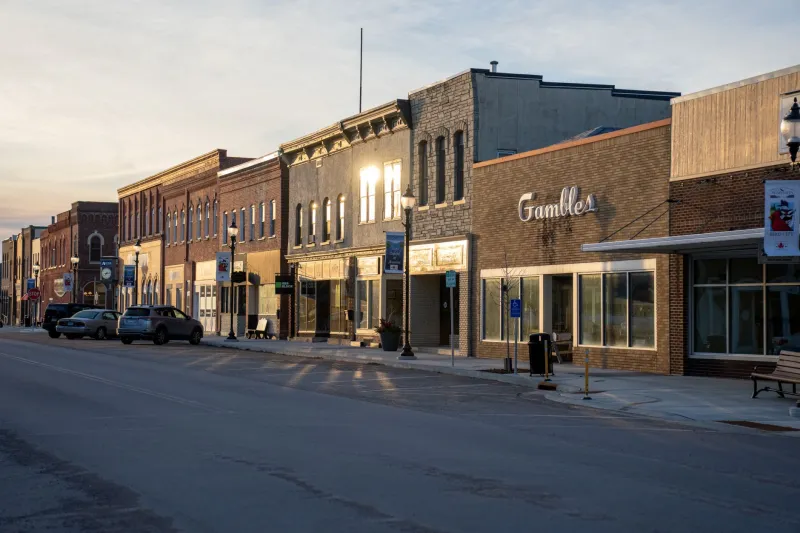
The Vanishing Facade: Inside the Quiet Mission to Photograph Main Street Before It's Gone
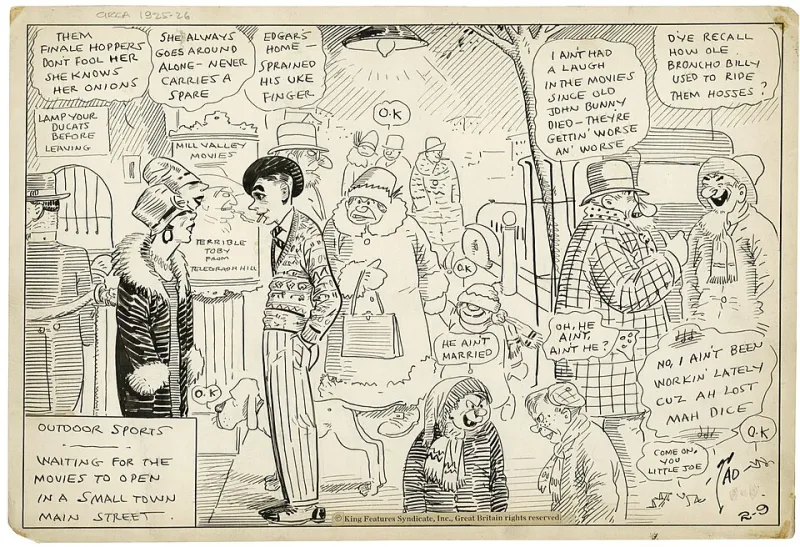
Photo: Tad Dorgan, Public domain, via Wikimedia Commons
On a gray Tuesday morning in Marietta, Ohio, a photographer stands in the middle of Front Street with a tripod and a wide-angle lens, waiting for the light to hit a 19th-century brick facade just right. The building houses a hardware store that has operated since 1904. There is no plaque, no marker, no formal record of its significance. There is only the photograph she is about to make.
Scenes like this are unfolding in hundreds of towns across the country, and they represent one of the most quietly important movements in contemporary American photography.
The Archive No One Commissioned
Official documentation of American towns tends to be incomplete. Historic registers prioritize architecturally significant structures. Municipal records capture dates and ownership, but rarely the character of a place — the neon sign of a bowling alley, the hand-painted window of a barbershop, the faded mural on the side of a feed store.
This is the gap that small-town photographers have stepped into. Working without institutional backing, they are building visual archives that no agency thought to create. Their subject matter is unglamorous by design: the diner that opens at five, the movie marquee with replaceable plastic letters, the grain elevator rising over a two-block downtown.
What makes these images remarkable is their accumulating value. A photograph of an ordinary storefront is a snapshot. A photograph of that same storefront, alongside thousands of others across four decades, becomes evidence — of architectural styles, of commercial culture, of how Americans lived and gathered.
Racing the Wrecking Ball and the Redeveloper
The urgency is not abstract. Downtown cores across the Midwest and South have been transformed by decades of economic shift. Big-box development, e-commerce, and the pandemic-era acceleration of remote commerce have hollowed out main streets that were already fragile. When a building comes down, what replaces it is rarely anything worth photographing.
Photographers who work this beat understand they are in a race. Some revisit the same block annually, building longitudinal records of change. Others focus on a single typology — roadside signage, movie theaters, drive-in restaurants — creating bodies of work with documentary rigor that academic historians often envy.
The best of this work resists sentimentality. The strongest visual historians of Main Street do not photograph decay for its own sake; they photograph use. A diner photographed at the lunch rush tells a different story than the same diner photographed abandoned. The difference between documentation and elegy is often just timing.
Why the Record Matters More Than Ever
Historians have long relied on the work of photographers like Walker Evans and Dorothea Lange to understand Depression-era America. Those images endure precisely because someone pointed a camera at ordinary life when it would have been easy to look away. Today's small-town documentarians are performing the same function, largely unnoticed.
Future researchers — urban planners, architects, cultural historians — will study these archives to understand how American commercial life evolved in the late twentieth and early twenty-first centuries. The photographs will answer questions no one has thought to ask yet.
There is also a civic dimension. When a town loses a landmark, the loss is often argued in economic terms. Photographs change that conversation. A well-made image of a threatened building gives preservationists something concrete to organize around, and gives residents a way to grieve and mobilize.
What Viewers Can Do
The people making these images rarely have institutional support, and there are practical ways to help sustain the work.
Buy the prints. Many of these photographers fund their projects through print sales and local exhibitions. A print of the theater where you saw your first movie is both personal artifact and direct support.
Share the archives. Local historical societies, libraries, and digital collection projects often accept donations of documentary photography. Connecting a photographer's work with an archive ensures its survival beyond any single hard drive.
Commission the record. Business owners and chambers of commerce can hire photographers to document their own buildings and streetscapes. A modest commission today can produce an image with enormous value in fifty years.
Credit the source. When these images circulate online, attribution matters. A photographer whose work is seen and credited can secure grants, exhibitions, and commissions that keep the project alive.
An Incomplete Portrait, Deliberately
No single photographer can document a nation. But the aggregate of hundreds of people photographing their own hometowns — with patience, consistency, and an eye for what deserves remembering — is producing something unprecedented: a distributed, democratic portrait of the United States at ground level.
It is a portrait made without grants or galleries, one frame at a time. And like all the best photography, it asks nothing of its subjects except that they continue existing long enough to be seen.